
Celebrating Volunteer Appreciation Month: How One Mentor Helped Transform a Veteran’s Life
And How This Veteran Now Is Paying It Forward
Every April, National Volunteer Month shines a light on the people who give their time, talents, and heart to strengthen their communities. It’s a celebration of the quiet helpers, the behind‑the‑scenes supporters, and the everyday individuals who step forward to make someone’s life better.
Few stories capture the spirit of volunteerism as powerfully as the journey shared by Marine Corps Veteran Omar Gonzalez and Rick Thill, executive director and market team lead at JP Morgan Private Bank as well as Omar’s mentor at MISSION UNITED.
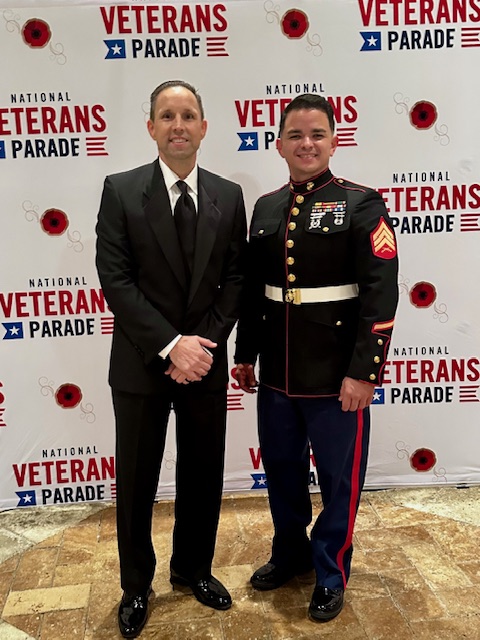
Their relationship — born from a chance encounter, cultivated through years of perseverance, and now at full circle — embodies exactly what National Volunteer Month is all about: how one person’s willingness to help can change the trajectory of another person’s life.
What began as a mentorship through MISSION UNITED has grown into a lifelong bond, a career transformation, and now a new generation of Veterans who are receiving support from another Veteran who once needed it himself.
Here is Omar’s and Rick’s story in their own words.
Q: Omar, can you tell us about your military background and what your service meant to you?
Omar: I served in the United States Marine Corps from 2006 to 2011. I started in security forces in Kings Bay, Georgia, and I finished with 1st Battalion, 3rd Marines. Overall, the military was a positive experience, and it shaped me in ways I didn’t fully understand at the time. There were hardships, of course, but I look back and see how much it helped me become who I am today.
Q: You have mentioned challenges after returning home. What were some of the struggles you faced in making the transition to civilian life?
Omar: I was 20 years old in Afghanistan. We did a lot of fighting, and it was pretty violent. When I came home, I struggled. I was angry, I drank too much, and I sabotaged myself. I knew I had potential. I felt smart and capable, but I didn’t know how to develop the tools to deal with what I was going through. That’s when MISSION UNITED entered my life.
Q: How did you first connect with MISSION UNITED?
Omar: It was February 2015. I was standing on a street corner in Coral Springs at an event with 22 Too Many. 22 Too Many is a nonprofit organization dedicated to honoring U.S. military service members who died by suicide and supporting the families they left behind. At this event in Coral Springs, I met United Way Broward’s Jonathan Davidson and Kathleen Cannon. Jonathan stayed in touch — even when I didn’t respond. I don’t know how many emails he sent, but because he was persistent, I ended up talking to him. Eventually, he told me about a mentorship program at MISSION UNITED, and he gave me a list of potential mentors willing to work with Veterans.
Q: Rick, here’s where you come in. Omar chose you, and you were one of the few non‑Veterans on the list. What do you remember about your first meeting?
Rick: We met at Old Heidelberg on Marina Mile Boulevard. There was no specific agenda — just the two of us talking. I remember thinking Omar was willing to sacrifice everything to move forward. He was planning to take pay cuts, work nights, shoulder all the burdens on himself. I told him “We have to change your mindset. You have value, and you have to belief in your value.” Veterans often come back with this deep sense of humility and self‑sacrifice, but if someone doesn’t shift this mindset, it can lead to a lifetime of struggles.
Q: Omar, what made you choose a civilian mentor instead of a Veteran?
Omar: I figured my future employer probably wouldn’t be a Veteran. I wanted someone who wouldn’t cut me slack because of any shared experiences. I wanted to learn how to navigate the civilian world from someone who lived in it every day and who succeeded in it.
Q: How did the mentorship evolve from those early conversations?
Omar: At first, it felt like a friendship. But over time, Rick helped me think differently about myself and my career. I was working in property management, and he helped me prepare for a better position at Castle Group, which is a great place to work. Then in 2017, when my wife and I found out we were expecting our third child, I realized I needed to build a career path that would support my family. I asked Rick how to do what he has achieved.
Rick: I told him the truth: He needed a degree in accounting or finance. And if he could handle it, accounting would open doors.
Q: That decision required enormous sacrifice. Omar, what was this period like?
Omar: Hard. Really hard. I went back to school part‑time at Palm Beach State, then full‑time at Florida Atlantic University. I took five classes per semester. I waited tables. I tutored. My wife and I moved into my parents’ house — two kids, one on the way, all in my old bedroom. But I kept going. I made the President’s List at FAU, and I graduated with a degree in accounting in May 2020.
Q: Then the world shut down. How did you navigate post-graduation during the pandemic?
Omar: I reached out to Rick. I said “I know everything’s crazy, but I graduated. Is there anything you can do?”
Rick: I had been working at BankUnited, and there was only one job opening at this time. I pulled every string I had. I convinced leadership to close a requisition in another department and create a new position for Omar. And then he earned all of his success in this position.
Q: Rick, you’ve mentioned that you got as much out of this mentorship as Omar did. What do you mean?
Rick: Helping Omar gave me purpose. Seeing him grow and seeing what a little support at the right moment can do is incredibly fulfilling. My family has a long history of military service, and the work with MISSION UNITED feels like I am honoring the legacy of my family and all Veterans.
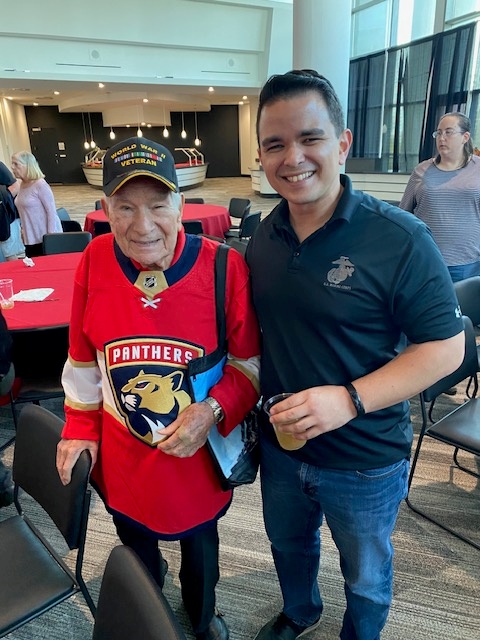
Q: You shared a story about the Florida Panthers wanting to honor Omar. What happened?
Rick: Jonathan from MISSION UNITED called me and said the Panthers wanted to recognize Omar on the ice. I said “He’s absolutely in.” But Omar turned it down because he had to work. I called him and said “What are you doing?” The Castle Group also encouraged him to participate, and we went the next season.
Omar: Rick really did all that. It was a pretty exciting experience, and I met all the Veterans who the Panthers have honored over the years in the same way.
Q: Omar, you’ve spoken very highly of Jonathan Davidson and the teams at MISSION UNITED. What impact have they had on your journey?
Omar: Jonathan was the glue. He was the common point in all of these different interests. He connected me to events, resources, people. He made sure my family had Thanksgiving meals when we needed them. He never made me feel like a burden.
Q: How would you describe MISSION UNITED’s mentorship program to someone unfamiliar with it?
Omar: It helps Veterans reintegrate into civilian life — not just socially, but professionally. It helps translate military skills into business skills. It helps reshape mindsets. It gives Veterans access to people who can open doors and guide them.
Rick: Perfectly said.
Q: Omar, you’ve now come full circle. You’re mentoring other Veterans through the Veteran Treatment Court program. What is this experience like?
Omar: It feels right. I have had promotions at BankUnited, and now I’m working in almost the same role that Rick had. And I get to help other Veterans who are where I once was. It’s has been extremely meaningful.
Q: Omar, what would you say to Veterans who are hesitant to reach out for help?
Omar: Cynicism doesn’t help anybody. What MISSION UNITED and its team and its volunteers are doing is the real deal. It’s not too good to be true. MISSION UNITED changed my life, and it can change yours too.
Q: Rick, what would you say to potential mentors or supporters?
Rick: There’s no organization like MISSION UNITED where volunteering your time and efforts has more direct impact. You can literally change someone’s life, and maybe the best part is volunteers like me can see the results.
Omar’s story is proof that mentorship isn’t abstract — it’s transformational. It’s one person choosing to show up for another. It’s a conversation that becomes a lifeline. It’s a volunteer who helps a Veteran rediscover their purpose. And it’s a Veteran who later does the same for others in need.
For Volunteer Appreciation Month, we invite you to be a part of the power of how we are helping people rise and thrive:
-
Become a volunteer or mentor with MISSION UNITED or one of our community-building programs
-
Join one of MISSION UNITED’s committees by emailing James Heaton at JHeaton@UnitedWayBroward.org
Your time, your experience, and your willingness to care can change lives— just like Rick’s generosity changed Omar’s and his family’s life.